
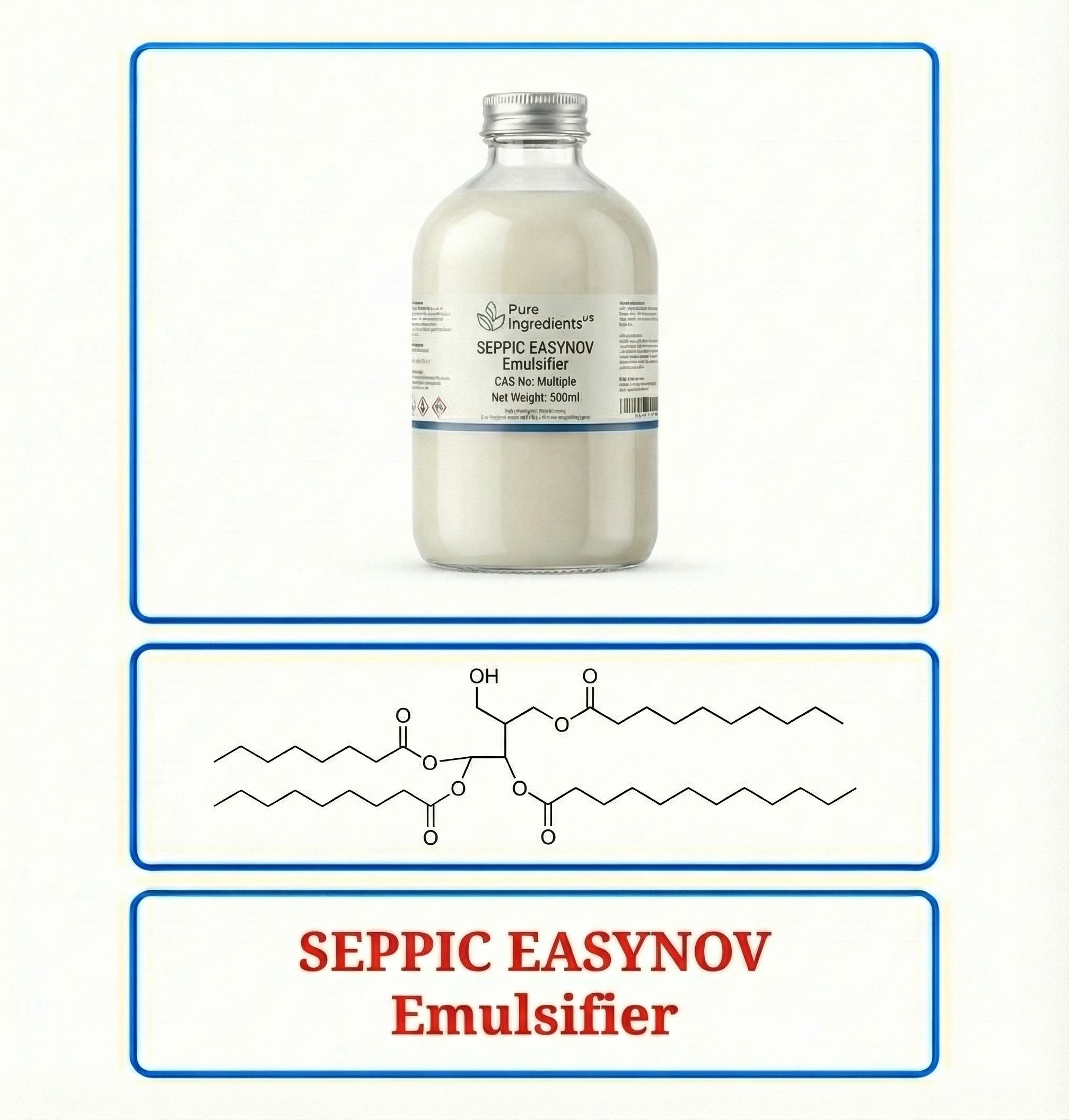
Description
Description
EASYNOV-Type W/O Emulsifier is a trade-reference liquid blend based on Octyldodecanol, Octyldodecyl Xyloside, and PEG-30 Dipolyhydroxystearate. The system is designed to create water-in-oil and gel-in-oil emulsions with high internal water phase, fresh sensory character, and cold-process flexibility.
Chemical & Technical Profile
| INCI / Identity | Octyldodecanol (and) Octyldodecyl Xyloside (and) PEG-30 Dipolyhydroxystearate |
|---|---|
| CAS No. | Mixture; no single CAS |
| Molecular Formula | Nonionic W/O emulsifier blend |
| Molecular Weight | Not applicable |
| Physical Form | Clear to pale yellow liquid |
| Solubility | Oil-phase soluble/dispersible |
| Functional Category | Cold-processable water-in-oil emulsifier |
Mechanism of Action / Technical Function
PEG-30 Dipolyhydroxystearate provides the principal lipophilic interfacial film around dispersed water droplets, while alkyl xyloside and octyldodecanol modify interfacial packing and oil-phase sensory properties. In W/O emulsions, stability depends on keeping water droplets finely dispersed within a continuous oil phase with sufficient interfacial elasticity and oil-phase structure.
Formulation Guidelines
Add the emulsifier to the oil phase, then incorporate the aqueous phase gradually under controlled homogenization. Cold processing is possible, but viscosity and droplet size must be developed intentionally; a gelled aqueous phase or oil-phase structuring can improve robustness. Electrolytes are often tolerated better in W/O than O/W systems but can still affect droplet behavior and preservation.
Compatibility & Stability
Monitor droplet size, conductivity, viscosity, centrifuge stability, water separation, and heat/cool cycling. W/O failures can be sudden if phase inversion occurs, so conductivity is a useful QC indicator. Type-grade performance should be verified in the actual oil blend.
R&D, Scale-Up & Quality Control
For EASYNOV-Type W/O Emulsifier, incoming and in-process QC should control EASYNOV-type blend appearance, conductivity, droplet size, and viscosity. Pilot transfer should lock oil-phase preparation, rate of aqueous-phase addition, homogenization, and continuous-phase structuring, because these variables directly influence reproducibility. Release the formulation only after the W/O system retains low conductivity and shows no inversion, water separation, or droplet coalescence.
Packaging, Shipping & Storage
Supplied in a tightly sealed liquid container. Store cool, protected from direct light and excessive heat.
Estimated Delivery: 10–15 Business Days
Applications
Rich facial creams, water-resistant skin care, makeup removers, barrier products, deodorants, sun-care emulsions, and gel-in-oil systems.
Related Ingredients
Hydroxyethyl Cellulose (HEC) • SEPINOV EMT 10-Type
Documentation & Use
- Certificate of Analysis (COA) for the lot shipped: available on request at info@pureingredients.us.
- Safety Data Sheet (SDS): available on request.
- SKU: PI-RM-0081
For cosmetic formulation use only. Not for direct application to skin.
Reviews
There are no reviews yet.